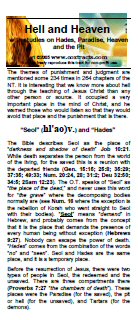
doct04 Hell and Heaven, Hades, & Paradise

Hell and Heaven with studies on Hades, Paradise, Heaven and the Pit
[d04] v1 ©2005 www.coxtracts.com
You may freely reproduce this tract for non-profit use.

The themes of punishment and judgment are mentioned some 234 times in 264 chapters of the NT. It is interesting that we know more about hell through the teaching of Jesus Christ than any other person or source. It occupied a very important place in the mind of Christ, and he warned those who would listen so that they would avoid that place and the punishment that is there.


Continue reading

ch41 The marks of a bad minister v1_1

The Marks of a Bad Minister
How to recognize him

How to discern a bad minister
By David Cox
[ch41] v1 ©2011 www.coxtracts.com
You may freely reproduce this tract for non-profit purposes

_______________

Ch41

The Marks of a Bad Minister
How to recognize him
By David Cox

[ch41] v1.1 ©2011, 2024 www.coxtracts.com
You may freely reproduce this tract for non-profit purposes

Matthew 7:20 Wherefore by their fruits ye shall know them. 21 Not everyone that saith unto me, Lord, Lord, shall enter into the kingdom of heaven; but he that doeth the will of my Father which is in heaven. 22 Many will say to me in that day, Lord, Lord, have we not prophesied in thy name? and in thy name have cast out devils? and in thy name done many wonderful works? 23 And then will I profess unto them, I never knew you: depart from me, ye that work iniquity. 24 Therefore whosoever heareth these sayings of mine, and doeth them, I will liken him unto a wise man, which built his house upon a rock:

At times, it is difficult to identify who is a true servant of God, and who is not. God has not left us without help in the matter though.

The Marks of an Unsaved Minister

It is interesting that in this minister’s defense before God, (Matthew 7:21-24) that God judged he wasn’t even saved! He defended himself before God in three proposed evidences of his “good minister of God status”: (1) his ability to prophesy, (preach) (2) his power over powers of evil, and (3) his work of miracles and great events. Many in our day want to validate their ministries in a similar fashion. They insist that they are true men of God, exalted ministers of the Highest God, because they have their distinct insight into the mind of God, because their power over demons and evil powers, and most certainly because they impress with what they have done for God, miracles, great works, etc. It is important to note that Jesus in no way tried to contradict what they presented. Perhaps their bragging had some validation in that something notable was on some level accomplished as they claimed. But Jesus’ hard position is that even with signs of great spiritual power; they had nothing to do with God and His Kingdom. Read Matthew 7:21 with great care. The ONLY MARK of a faithful minister is to be always “stuck” on the will of God.Greatness,” validity, and identification with God is only found in strict obedience to God’s will. Those that exalt God’s will over their own.

Useless Ministers

Matthew 24:48 But and if that evil servant shall say in his heart, My lord delayeth his coming; 49 And shall begin to smite [his] fellowservants, and to eat and drink with the drunken; 50 The lord of that servant shall come in a day when he looketh not for him, and in an hour that he is not aware of, 51 And shall cut him asunder, and appoint him his portion with the hypocrites: there shall be weeping and gnashing of teeth.

In this passage that deals with various parables on service and the child of God, it is very instructive that the evil “servant of God” goes to hell in the end. So we must open the possibility that many supposed ministers of God, preachers, evangelists, or even pastors that exercise official positions in the church, just are not even saved.

The key factor that indicates their salvation is simply their disposition and attitude towards the will of God. The deceiving hypocrite is he who follows his own will in place of exalting the will of God in his life (and ministry) and doesn’t submit to God. These people always pretend to have “biblical ministries”, and they are experts in rhetoric because “they are biblical” or in giving reasons why they are truly “ministers of God”, but if you listen closely, you will see how lightly they respect the Word of God, or how astutely they twist God’s Word to suit their desires, aspirations, and ambitions. They “use” and abuse the Word of God for their own purposes and are not under its authority. True ministers that please God are people who always rely on the authority of Scripture as their authority, but also as THEIR GUIDE,

Jeremiah 3:15 And I will give you pastors according to mine heart, which shall feed you with knowledge and understanding.

Those that cause Division and Desolation

Jeremiah 23:1 Woe be unto the pastors that destroy and scatter the sheep of my pasture! saith the LORD.

One of the principle jobs of the pastor is to gather sheep. This is in one of two forms, both of which fully apply: (1) the evangelization of the unsaved bringing them into the fold (the local church), (2) To visit and encourage members of their church that have stopped coming, to return and actively participate in the church once again. The identifying mark of a fraudulent pastor is that he divides the church by his brutal actions, his cruel attitude, and in general by his style of leadership (way of doing things) which works against gathering and unity. Unity comes because all think alike, and act with the same spirit, carrying the same doctrine. This is not by forceful imposition by authority figures, but by mutual submission to God’s authority.

The good pastor explains the actual text of the Bible, but he also investigates, defines, and insists on the Scriptures ruling over everything the church is and does. The wicked pastor imposes his own will without respect to nor support of Scripture, except some twisted, unclear mental gymnastics. The will of God is grossly abused, mistreated and misrepresented. Jeremiah (Jeremiah 25:34) refers to their days of “slaughter”, which is to die and not live. The sheep ought to have a spiritual life within them, and the good pastor will promote this. The bad pastor destroys and kills this spiritual life among his sheep. He undermines, disrupts, and cuts off this spiritual relationship between believer and God (spiritual death). He takes the place of God in their lives.

Leadership by Force and Imposition

Jeremiah 23:2 Therefore thus saith the LORD God of Israel against the pastors that feed my people; Ye have scattered my flock, and driven them away, and have not visited them: behold, I will visit upon you the evil of your doings, saith the LORD. And I will set up shepherds over them which shall feed them: and they shall fear no more, nor be dismayed, neither shall they be lacking, saith the LORD.

The style of ministry of a wicked, ungodly pastor is very particular. He scares people with sharp, loud (notorious) actions with lack courtesy and love towards them. He imposes on the brethren, and his objective isn’t to correct sin, but to impose and ingrain his own authority over the people of God. The idea in verse 4 is that (1) they use fear – which is the anticipation of some bad interaction with the pastor. (2) They cause the sheep to be dismayed, which has the idea of submission by means of dragging or violent force, fear, or confusion. He is marked by his leadership style of cruelty, unthinking actions, and an uncaring attitude towards his sheep, anything as long as they obey him. (3) Be lacking – This word is the opposite of pastoral visitation, where the pastor inspects and then handles whatever need they might have. This is totally and importantly lacking.

Errors and the Erring

Jeremiah 50:6 My people hath been lost sheep: their shepherds have caused them to go astray, they have turned them away [on] the mountains: they have gone from mountain to hill, they have forgotten their resting place.

There is a specific way in which we sheep should walk, and this is the way of God which Jesus showed us. It is to be spiritual, have faith, and depend on God, and is to complete the work of God on earth. A false pastor is somebody who guides the sheep (he is a pastor), but not in the way of God, and this results in a road that isn’t in the will of God.

This kind of pastor doesn’t bring the unsaved into a saving relationship “with the Master” (the bad minister isn’t saved himself), but rather he collects people to obey his rule and authority stolen from God. This wicked pastor isn’t laboring in intercession and prayer for others, nor does he have compassion and love for those in error, sin, or the unsaved. He may be very astute (usually is), but his presentations, teachings, sermons don’t show great insight and understanding into Scripture, rather they are tools to build his empire.

A true man of God is concerned that others submit to God’s will, and rebuke of sin and repentance from sin are regular objectives of their ministry (moral change). The false prophet is greatly disgusted over all this, and he will make false repentance over meaningless issues, and he regularly pleases himself with indulgence into sin of some kind. But his prime objective is that everybody follows his will, nobody can think or discern God’s will except the pastor.

Rather than understanding Scripture for themselves, the wicked pastor confuses the issues that most press against his own personal sins, distracting, detracting from the importance of him repenting of his own sin. He substitutes tradition (“we have always done it this way”), authority of his office (“I am pastor, and I call the shots here”), or he appeals to popularity. A good pastor preaches sermons to himself first, and having repented himself first, and makes it a great sermon for all. You can mark the bad pastor by his drive to change the traditional, New Testament presentation of what “church is” to a modern version that is more accommodating to our tastes. Reverence, worship, and exposition of God’s actual words are replaced with an entertainment type attitude and environment, where “judging and rebuking sin” is not seen nor present except in unbiblical ridiculous ways.

John 6:28 Then said they unto him, What shall we do, that we might work the works of God? 29 Jesus answered and said unto them, This is the work of God, that ye believe on him whom he hath sent.

The work of God focuses on the person of Jesus Christ, our Savior but also in the spiritual image of Christ. We should imitate Christ. Paul presents this command (Ephesians 5:1).

1 Corinthians 11:1 Be ye followers of me, even as I also am of Christ.

Philippians 3:17 Brethren, be followers together of me, and mark them which walk so as ye have us for an ensample.

Hebrews 13:7 Remember them which have the rule over you, who have spoken unto you the word of God: whose faith follow, considering the end of their conversation.

Ezekiel 37:24 And David my servant shall be king over them; and they all shall have one shepherd: they shall also walk in my judgments, and observe my statutes, and do them.

Why” God gives good shepherds “according to the heart of God(Jeremiah 3:15) to the sheep is so that they can direct the sheep INTO God’s way, God’s will, obeying God. Churches today get involved in all kinds of foolishness except the actual work of God as presented in Scripture, evangelism in the street, prayerful intercession, exposition of Scriptures… A bad pastor will “tend away from these things,” not following Christ’s example.

Feeding themselves

Ezekiel 34:2 Son of man, prophesy against the shepherds of Israel…Woe be to the shepherds of Israel that do feed themselves! should not the shepherds feed the flocks? 3 Ye eat the fat, and ye clothe you with the wool, ye kill them that are fed: [but] ye feed not the flock. 8 As I live, saith the Lord GOD, surely because my flock became a prey, and my flock became meat to every beast of the field, because [there was] no shepherd, neither did my shepherds search for my flock, but the shepherds fed themselves, and fed not my flock;

Wicked pastors tend to feed themselves, not entering into personal sacrifice, personal risk or adversity, but they seek the “easy life”. They want others to give them a good economic life, but they don’t do the real work of God the right way. Spiritual fruit and abandonment of sin are not the natural products of their ministry or life.

Download

More Tracts from the Church Category

Author Pastor David Cox

Pastor David Cox

ch42 Destitution of Pastor

Destitution of the Pastor

The Destitution of the Pastor

Considerations and Reasons in which the Pastor should leave his office.

By David Cox
[Ch42] v1 ©2011 www.coxtracts.com
You may freely reproduce this tract for non-profit purposes.


The Destitution of a Pastor: considerations and reasons why the pastor should step down

By David Cox

[ch42] v1.1 ©2011, 2024 www.coxtracts.com
You may freely reproduce this tract for non-profit purposes

There are often problems in churches between the pastor and the members. In general, the pastor is the one who governs and leads the church according to what God teaches him. In itself, the concept of a Pastor is to lead (or govern) the flock of God. The Bible does not indicate that the church can remove the Pastor, because it simply does not like a matter that he does, especially when it is of minor importance. But the pastor is not without his duties and responsibilities either. He cannot do whatever he wants. For some, the pastor is “untouchable.” Once he enters, nothing short of God killing him, or the pastor himself resigning that can remove him. But that is not the case.


Is it Biblical to Destitute the Pastor?
(to remove him)

In 1 Timothy 2:11-15; 3:1-7; and Titus 1:5-9, the Apostle Paul explained the requirements for the bishop, who is the one who cares for the church spiritually and governs it. In making requirements, God gives us to understand that (1) not everyone is qualified to be a pastor, and for this reason, there are requirements before entering the office of bishop. (2) if a pastor officiating and ministering as a bishop becomes disqualified, then he must step down from that position and ministry. It is not valid to dismiss the pastor because you do not like something he does. Each person has “his style” of leadership and of doing the ministry and being a pastor. It is his privilege to direct things as he sees fit. The dismissal must come because he does not fulfill his duties, or for reasons of breaking a biblical norm, a biblical example, or not being exemplary (according to what most men of God and more spiritual Christians in the group see). In 1 Timothy 5:19-20, it clearly speaks of an elder’s rebuke openly before everyone, so pastors are not untouchable.

Subject to Requirements 1Timothy 3:2-3

Many times, wolves or immature men can deceive with their cunning, and for this reason, God says that the deacons and the pastor must be tested first, and then exercise their ministry if they are blameless (1 Timothy 3:10), i.e. meet the requirements. Paul put “these also” with the deacons so that we understand that the test is applied to the pastor as well as the deacon. Likewise, in reading Jeremiah (19 times) and Ezekiel (9 times almost all in chapter 34), God rebuked the errors and faults of the shepherds of Israel (the spiritual leaders of the nation). God rebukes them and speaks repeatedly of their dismissal, and that God is going to exchange them for a man of God who would do the will of God.

Jeremiah 3:15 And I will give you pastors according to mine heart, which shall feed you with knowledge and understanding.

1 Peter 5:2 Feed the flock of God… Neither as being lords over God’s heritage, but being ensamples to the flock.

The pastor is the local living example of Christ (if not, he should step down). His leadership and ministry are one of demonstrating the will of God by the current and historical example of his own life. That is, before spiritual authority, before teaching or preaching, the pastor teaches and guides BY WHAT HE IS SPIRITUALLY. It is hypocrisy to say, “do as I tell you, not as I personally do.” So, if this is the basis of his ministry, when the pastor does not live correctly, he is not blameless like the example of Christ, he should step down or be dismissed.


The Requirements for Being Pastor

According to 1 Timothy 2:11-15; 3:2, it is expressly forbidden for a woman to serve as a pastor, or to preside, or to lead, or to preach, or to teach before the mixed group (men present) or in the general assembly (in any way speaking and being in front of the group in an official or authoritative capacity) or the church (when men are present). Simply put, the job of pastor-bishop is for men, not women.

It is equally forbidden if the pastor is not or does not continue to be “a one-woman man.” Homosexuals, adulterers, or divorced people are excluded from this ministry. The job of pastor is to teach and counsel the group by word and deed. If he does not live up to biblical standards, he should not enter, and if he should “change his mind” about the standards, he should either leave or be removed. God requires that the pastor “be blameless,” and this means that the pastor is an example of Christ, and has no defects, stains on his testimony, or is of bad report. We all sin, but the pastor must be a man who by his personal life’s achievement in following Christ is qualified to stand before others. He is not given to wine, vices, and addictions, but is free from them.

The Character of the Pastor

Although we can say that it is the privilege of each pastor to lead the group in general as he wants, there are conditions in this as well. First, it is appropriate to use this as a shield to not comply with God’s standards. These standards are obligatory for every believer, whoever he may be, but the pastor must especially manifest submission and obedience to them. The requirement of not being arrogant means not having an attitude of haughtiness, that is, that he is better than others, and does not care about the lives, feelings, or well-being of others. The pastor is there to give the flock the social, emotional, and spiritual support of God. His purpose of being over the flock is exactly this, to take them to a place of spiritual good, and to take care of them there, and any problem that exists, the pastor is there to correct it, to place the brothers in God’s will, or to give comfort if there is nothing else to do (such as the death of a family member). So, the biblical pastor is marked or distinguished from the evil pastor by being prudent and decorous, a host (1 Timothy 3:2). Prudence is saying the right thing, acting in a noble and healthy way, in a way that others see your behavior as the best in the world.


Being of good behavior and hospitable means having your life in order, everything as it should be, and having a “pro-people” attitude and actions. The biblical pastor wins others to Christ and serves the people of God by his attitude and actions of “being by their side” and not against them. Although sometimes the pastor must take the position of the beloved father who scolds his child, he loves, his actions, words, and attitude are always to benefit and edify the people (so that they walk in the will of God), and not to attack and destroy them. God has imposed that pastors live from this work, but the difference between the wolf and the beloved pastor is simply their attitude toward the will of God and the flock. The good shepherd wants to be God’s instrument to bless them and edify them so that they become adults, mature Christians. For this reason, the pastor does not stoop to the whims, tantrums, outbursts of anger, and the chatter of foolish old women. This is also involved with not being a novice (1 Timothy 3:6), but someone who, through his ALREADY ESTABLISHED experience in the ministry, demonstrates his spiritual and emotional stability. Titus 1:7 mentions “not soon angry” or hot-tempered as a character that disqualifies the person, and this is angry, emotionally explosive, always ready for, looking for and liking fights, arguments, and struggles. 1 Timothy 3:3 uses the phrases not a striker and not a brawler, or the concept of not being quarrelsome, which means that it is a person who loves to fight and win over others and to roll in fame and recognition of his superiority from others. The good shepherd is not like that, but he is controlled, demonstrating the way of God, the character of Christ by his own life, and this is the idea of ​​“prudence.”

2 Timothy 2:24 And the servant of the Lord must not strive; but be gentle unto all men, apt to teach, patient, 25 In meekness instructing those that oppose themselves; if God peradventure will give them repentance to the acknowledging of the truth; 26 And that they may recover themselves out of the snare of the devil, who are taken captive by him at his will.

In 1 Timothy 3:3, Paul specifically states that the person who occupies the place of leader-example of the church must be “gentle, mild.” This means that he is a person with patience, and that he is gentle in his dealings with others, a true “gentleman”. His life demonstrates the gentleness, calmness, and patience of Christ, and if not, then he should not enter, nor should he remain as a shepherd. Isaiah 40:11 also refers to this gentleness and mildness that should be the norm between shepherd and sheep.


Greedy Dogs and Insatiable

Isaiah 56:11 Yea, they are greedy dogs which can never have enough, and they are shepherds that cannot understand: they all look to their own way, everyone for his gain, from his quarter.

Furthermore, the Bible emphasizes time and time again that the false prophet always has his eye on money and how he can reap what is not rightfully his, and the man of God is a person “not greedy of dishonest gain” (1 Timothy 3:3; Titus 1:7).

How do you remove this a Bad Pastor?

There are two possibilities here, the nice way, and the ugly way. The Nice Way. When a Christian who has a viable and living relationship with Jesus Christ as his Savior enters the position of pastor of a church, and he falls into sin, or lets his testimony fall, or becomes bitter in his attitude, he by himself, by his own conscience, will want to step down from being a pastor so as not to tarnish the name of his Savior.

1 Peter 2:11 Dearly beloved, I beseech you as strangers and pilgrims, abstain from fleshly lusts, which war against the soul; 12 Having your conversation honest among the Gentiles: that, whereas they speak against you as evildoers, they may by your good works, which they shall behold, glorify God in the day of visitation.

The true Christian cares a lot about how his life reflects on his Savior. Because of stains in his testimony (his way of living), others do not come to Christ, or they stumble over his bad testimony, and this should be a strong motive in any Christian not to fall into sin, and if he does fall, to correct his life quickly, and not to occupy places of prominence during or after his sin or bad testimony.

The bad way. Unfortunately, the wolf does not care about any of this, and simply his hold on power over the church and the brethren is exactly like a dog with a bone. You are going to have an ugly fight if you try to take away his prize. (This is why the process of selecting a pastor must take its time, be a calm, quiet process, and understanding the requirements and praying over them and each possible candidate before anything formal and permanent is done.) The only thing that causes a dog to give up his bone is a strong blow to the head with the shepherd’s staff. This is why they used this staff. They will defend “their prize” with vengeance. It will be a challenge to “touch not God’s anointed” (See my tract of this same title, Ch26).

Titus 1:13 This witness is true. Wherefore rebuke them sharply, that they may be sound in the faith.

God wants us to rebuke the erring Christan sharply at times to bring about spiritual healing in our lives and churches. Unfortunately, at times, even pastors get out of line. The more spiritual men of the church should speak strongly to the pastor to remove him if he does not fulfill his duties and requirements. Strong words of exhortation and encouragement should be given (constantly) before a removal process is begun. The pastor needs to know that his people are not ignorant of the image of Christ we all must bow before, and that they are aware of the pastor’s testimony (good or bad).

Download

More Tracts from the Church Category

Author Pastor David Cox

Pastor David Cox

ch092 The False Prophet’s Spectacles

ch092 The False Prophet’s Spectacles is an examination of the unbiblical methods a false prophet uses to attract new people to his church.

The False Prophet’s Spectacles
By David R. Cox

[ch92] v1 ©2024 www.coxtracts.com
This tract can be freely reproduced for non-profit purposes

Matthew 7:15 Beware of false prophets, which come to you in sheep’s clothing, but inwardly they are ravening wolves. 20 Wherefore by their fruits ye shall know them. 21 Not every one that saith unto me, Lord, Lord, shall enter into the kingdom of heaven; but he that doeth the will of my Father which is in heaven. 22 Many will say to me in that day, Lord, Lord, have we not prophesied in thy name? and in thy name have cast out devils? and in thy name done many wonderful works.

Matthew 24:11 And many false prophets shall rise and shall deceive many. 24 For there shall arise false Christs, and false prophets, and shall shew great signs and wonders; insomuch that, if it were possible, they shall deceive the very elect.

So, why would a saved person support such ministries?

These false prophets made many supernatural shows in the name of Jesus. One of the marks that Jesus gave us to discern the false prophet is that they prefer making shows to identify themselves as being truly of God. Jesus declared something that was a strong shock, “I never knew you.” We must meditate on this. There are ministers and churches where those in control, that is, those who preach and teach in such a “ministry” are not even saved. So, why does a saved person have anything to do with them?

What is the Declaration of the Gospel?

Ephesians 2:17 And came and preached peace to you which were afar off, and to them that were nigh.

We must understand what the gospel is, and how we are to treat it in terms of what we say to others regarding salvation. There is a lot of importance in this. I mean, if you don’t understand what the gospel is, what salvation is and how you obtain it, you will never be able to enter it, nor will you treat it well.

A False Prophet does not explain the Gospel very well. A good pastor must explain salvation constantly and with different presentations. For the false prophet, the gospel is the repetition of magic words that if you repeat them, you will be saved. In areas of Catholic cultures, they must dip people in baptismal water (water baptism does not save anyone), but that is what the Catholic Church teaches. A preacher faithful to God will explain the gospel many times with clarity and care so that people understand salvation. Just saying or repeating a few words will not save anyone. Salvation comes when one hears the gospel and understands it, but the point of being saved is when the person believes in the gospel, his life changes and he is born again.

The World is Given over to Riches

The world is crazy in its desire for economic gain. The gospel is a spiritual orientation to remove the desire for material things. In other words, we begin with sin. We are in error, because we exalt riches to be our god. But our problems go beyond that. When a church or ministry attracts people through its economic giving of gifts, it is not right.

Genesis 3:1 Now the serpent was more subtil than any beast of the field which the LORD God had made. And he said unto the woman, Yea, hath God said, Ye shall not eat of every tree of the garden,

Matthew 4:3 And when the tempter came to him, he said, If thou be the Son of God, command that these stones be made bread. 4 But he answered and said, It is written, Man shall not live by bread alone, but by every word that proceedeth out of the mouth of God.

God declares that human needs (and desires) should not dictate how you live your life. It is a deception of Satan that you always have economic gain.

Fasting is exactly a spiritual activity to prove to the person himself that his spirit can dominate his body. But people can’t seem to live without exalting economic gain above everything else. Jesus said several times that we will always have the poor with us (Mark 14:7; John 12:8) and in Deuteronomy 15:11 He commands us to “Thou shalt open thine hand wide unto thy brother, to thy poor, and to thy needy.” We are to be generous to those in need. 1 John 3:17 But if anyone has the world’s goods, and sees his brother in need, and closes his heart against him, how does the love of God abide in him?

But there is a type of people who always have their hand outstretched, and they are not actually saved, and God’s work cannot be done with such types. But the false prophet uses people and finds it useful to give gifts to people who are greedy in order add them and better control them.

John 6:26 Jesus answered them and said, Verily, verily, I say unto you, Ye seek me, not because ye saw the miracles, but because ye did eat of the loaves, and were filled. 27 Labour not for the meat which perisheth, but for that meat which endureth unto everlasting life, which the Son of man shall give unto you: for him hath God the Father sealed. 28 Then said they unto him, What shall we do, that we might work the works of God? 29 Jesus answered and said unto them, This is the work of God, that ye believe on him whom he hath sent.

Salvation involves a spiritual change in the person’s being in which he leaves the importance of the earthly and the temporal in order to obtain the spiritual. We must live every moment of every day trying to please God. And this means working to sustain ourselves.

2 Thessalonians 3:10 For even when we were with you, this we commanded you, that if any would not work, neither should he eat.

So, our charity to these people must be limited lest we aid people in their sin, but it is totally a sin and the wrong way to live if one always seeks for “a handout.”

Jesus lamented that they would always follow whoever was giving handouts. These followers are not saved but are looking for the handout. They are children of Satan. Satan only has this world, that he has corrupted. He can only bribe people into his realm based on corrupted earthly things. The children of God have heaven and their future in it, blessings without number.

But a child of Satan habitually focuses on what he is going to enjoy now and in this life. Nothing else matters to him.

Romans 12:2 And be not conformed to this world: but be ye transformed by the renewing of your mind, that ye may prove what is that good, and acceptable, and perfect, will of God.

Luke 12:15 And he said unto them, Take heed, and beware of covetousness: for a man’s life consisteth not in the abundance of the things which he possesseth. 16 And he spake a parable unto them, saying, The ground of a certain rich man brought forth plentifully: 17 And he thought within himself, saying, What shall I do, because I have no room where to bestow my fruits? 18 And he said, This will I do: I will pull down my barns, and build greater; and there will I bestow all my fruits and my goods. 19 And I will say to my soul, Soul, thou hast much goods laid up for many years; take thine ease, eat, drink, and be merry. 20 But God said unto him, Thou fool, this night thy soul shall be required of thee: then whose shall those things be, which thou hast provided? 21 So is he that layeth up treasure for himself, and is not rich toward God.

The true Christian has changed their way of thinking. They esteem and value what is spiritual, and the rewards in heaven are more important than anything the earth has to offer.

Judas Iscariot followed Jesus also and he when to hell anyway

John 12:6 This he said, not that he cared for the poor; but because he was a thief, and had the bag, and bare what was put therein.

[literally “bare away” as in carry off the money]

What we must notice is that for some, money and what is economically convenient for them is more important than anything else, and so their god is wealth. In other words, one’s financial well-being controls the decisions of one’s life. Because of this detail, God commands us to give offerings. God commands every believer, every follower of Him, to give spiritual sacrifices of their possessions for His work. There is another important point. How much does a Christian sacrifice of his own life to show God that wealth is not his god?

Matthew 6:24 No man can serve two masters: for either he will hate the one and love the other; or else he will hold to the one, and despise the other. Ye cannot serve God and mammon.

Likewise, sacrifice, prayer, and meditation must be done so that this sacrifice does not go to a false prophet. But the point we see today is when a ministry attracts people through this greedy desire among the people, how can anything good come out of it? We are part of the “ministry” of the false prophet by attending, supporting him, going for what he gives away, or directing others to him. It is worse when you give money to the falsehood he represents.

The False Prophet uses Avarice[1]

[1] Immoderate desire for wealth; cupidity. An excessive or inordinate desire of gain; greediness for wealth; covetousness; An inordinate desire for some supposed good.

2 Peter 2:3 And through covetousness shall they with feigned words make merchandise of you: whose judgment now of a long time lingereth not, and their damnation slumbereth not.

The matter here is not just that the false prophets are covetous, but they use the covetousness of people to deceive them and to entrap them in webs of wickedness.

2 Peter 2:14 Having eyes full of adultery, and that cannot cease from sin; beguiling unstable souls: an heart they have exercised with covetous practices; cursed children: 15 Which have forsaken the right way, and are gone astray, following the way of Balaam the son of Bosor, who loved the wages of unrighteousness;

We have to understand the economic motive in ministries that give away free things in order to attract people. On the one hand, they give away things in order “build their ministry.” But to appear like a great spiritual success (because the economic attraction is what is actually happening here), they use this to raise funds from Christians that believe their lies of success. In other words, they use numbers to promote themselves.

There is no Real Repentance in Their Ministry

Jeremiah 8:4 Moreover thou shalt say unto them, Thus saith the LORD; Shall they fall, and not arise? shall he turn away, and not return? 5 Why then is this people of Jerusalem slidden back by a perpetual backsliding? they hold fast deceit, they refuse to return. 6 I hearkened and heard, but they spake not aright: no man repented him of his wickedness, saying, What have I done? every one turned to his course, as the horse rusheth into the battle.

These false prophets do not preach the whole counsel of God (Acts 20:27), because it is not convenient for them. They want a great number of people (that will provide them with money, luxuries, fame, and control of their people), and whatever hard thing that should be preached or that might turn away some of their crowds is avoided. When the false prophets have control over many people, they reach their goals. They are embarrassed when people have spiritual problems, and they don’t deal with that kind of thing.

Ezekiel 34:2 Son of man, prophesy against the shepherds of Israel, prophesy, and say unto them, Thus saith the Lord GOD unto the shepherds; Woe be to the shepherds of Israel that do feed themselves! should not the shepherds feed the flocks? 3 Ye eat the fat, and ye clothe you with the wool, ye kill them that are fed: but ye feed not the flock.

(To feed is to remedy their spiritual problems.) God used the prophet Ezekiel to get their attention and to instruct us as well. If a church comes to have thousands of members, how can it care for them individually?

Miracles and Healings

John 6:2 And a great multitude followed him, because they saw his miracles which he did on them that were diseased.

But we observe and analyze what people are like, and what is it that pleases God? The world lives looking at the earthly and as if it is the most important thing here on earth now. In other words, God warns us many times that our sin brings eternal and earthly consequences, and death. Then, God warns us with an illness that our sins will cause us to die. We have limited time to fix our lives. But few are those who use this time for their eternal good. It is the judgment of God that will fall upon one at any moment, and it is certain that it will fall. The false prophet identifies himself with saying good words instead of rebuke when the judgment of God is about to come.

Jeremiah 23:17 They say still unto them that despise me, The LORD hath said, Ye shall have peace; and they say unto every one that walketh after the imagination of his own heart, No evil shall come upon you.

The false prophets do not preach strongly, but only want to appear as if they do. They do not preach towards moral change in their people so that they imitate the moral character of God. It would ruin their goals of success if they did.

Elijah and the Prophets of Baal Wasn’t it sensationalism what Elijah did?

In 1 Kings 18, Elijah went “toe to toe” with the prophets of Baal.

1 Kings 18:33… Fill four barrels with water, and pour it on the burnt sacrifice, and on the wood. 34 And he said, Do it the second time. And they did it the second time. And he said, Do it the third time. And they did it the third time. 38 Then the fire of the LORD fell, and consumed the burnt sacrifice, and the wood, and the stones, and the dust, and licked up the water that was in the trench.

There are some that would say that Elijah fought against the false prophets of Baal, and by this, they also put an axe against physically destroying the icons of false religions. But if we examine the Bible, Elijah did not destroy any idols. He prayed, and God did a miracle that they couldn’t do.

They caused Harm to the Gospel

2 Peter 2:2 And many shall follow their pernicious ways; by reason of whom the way of truth shall be evil spoken of.

Because the truly saved support the ministries of these false prophets, the world thinks that all Christians are like this, and it is not true.

Download
salv02 Now that you have Believed

Now that you have Believed

By David Cox
[sal02] V2 ©2006 www.coxtracts.com
This tract may be freely photocopied.

_________________________

First steps for the new believer

(1) You should read and study the Bible daily.
(2) You should pray to God daily.
(3) You should be baptized in a good church.
(4) You should assemble in a good church.
(5) You should participate in the work of God.
(6) You should shun sinful habits.
(7) You should seek to serve God.
(8) You should honor God with your money by tithing.

Many new Christians begin to faint in the first steps of their Christian life. There are always hard times, but you should not give up. The dedication in your soul should be set to go ahead with God and with the things of God, and this is more important than anything else in your life. Put the priority of your life in God and the church. At times some people can hurt you very much, and at times it may even be a Christian brother or your own church. But you need to keep your vision set on Christ, not on men. Follow Christ no matter what the rest does.


Continue reading

salv31 Easy-Believism

By David Cox
[salv31] v1 ©2012 www.coxtracts.com
You may freely photocopy, print, or reproduce this tract for non-profit purposes


Then said one unto him, Lord, are there few that be saved? And he said unto them, Strive to enter in at the strait gate: for many, I say unto you, will seek to enter in, and shall not be able. Luke 13:23-24

Easy believism proposes that salvation is given by God on the sole criteria of a public declaration of faith in the promises of God and without any real change in the life of the saved (as seen in repentance). It is identified by its presentation of the gospel “without any difficulties in entering” and “without any obligations or responsibilities after one is saved.” This position doesn’t take into account the “difficultness” of entering heaven (Mt 19:24) nor the obstacle of coveting riches “afterward” which revealed unsavedness (Mark 10:24), or the young rich man who wanted salvation but didn’t get it because riches was above Christ (Mark 10:17-22). Wide is door to hell, but narrow and difficult is the entrance into heaven, so few find heaven (Mt 7:13). Christ demands simpleness as a child (Mt 18:3).

What is “Easy-Believism”?

Eph 2:8 For by grace are ye saved through faith; and that not of yourselves: it is the gift of God: Eph 2:9 Not of works, lest any man should boast.

What does this passage really teach? The context is the leaving “the course (current) of this word” (2:2) which we followed before being saved, and which we left to follow Christ. It speaks of communion with God which sin breaks. The Bible very clearly affirms that we are not saved by works of righteousness that WE have done (Titus 3:5), but that salvation is a gift, which is grace or mercy on God’s part. When we speak of how we obtain salvation, it is only through faith. It is the gift of God (grace) which is not something that we deserve or buy by means of good works. Our part in obtaining this gift of God is 1) repentance of our sins (Luke 13:5 …except ye repent, ye shall all likewise perish.) 2) Putting our faith or confidence in the spiritual work of Jesus Christ dying in the cross to pay the punishment of God on sin. Salvation comes from God (not “from us”), but God does not give salvation to everybody, but only to those which abandon (repentance) these forms, ideas, and previous beliefs about how they are just, how they can get to heaven, and how to be saved. God saves those that trust in what God has provided as the means (Jesus dying for your sin on the Cross of Calvary). Repentance is not always mentioned as clearly as faith because really it is the same thing as faith in Jesus Christ. We abandon (repent of) what we formerly believed in order to believe in Jesus as the solution. Faith and repentance are “two sides of the same coin”. Easy believism is a lack of focus on repentance (leaving off sinning) leaving the person simply asking for salvation in order to be saved.

The Need of Evidence for your Faith

Jas 2:17 Even so faith, if it hath not works (evidence), is dead, being alone. 18 Yea, a man may say, Thou hast faith, and I have works: shew me thy faith without thy works, and I will shew thee my faith by my works.

Many confuse these elements. The cults and false religions hold that you have to have “good works” in order to be saved, and they present salvation as a scale with sin on one side and good works on the other. But there is no good work that can cancel the punishment for even one single sin. What James is referring to here is that true faith will always have a force behind it that produces good works (evidence) within the Christian’s life. We should understand faith causes salvation in us, and good works do not have that capacity. Understanding this base, then we go on with faith is made valid and real by changes that it has produces in our life.

John 3:3 Jesus answered and said unto him, Verily, verily, I say unto thee, Except a man be born again, he cannot see the kingdom of God. 7 Marvel not that I said unto thee, Ye must be born again.

Salvation is a drastic change of life, in which Jesus defined eternal life with a necessary spiritual change of life (be born again). Salvation is never a repeating of a prayer, but it is always faith, believing in, and public confessing Jesus by words and deeds. Easy believism focuses on the benefit of being saved (going to heaven), but does not explain nor present emphatically the responsibilities of salvation. It is called “easy believism” because there are no obligations on the person wanting salvation, distorting true salvation of God.

Salvation is a Relationship

John 17:3 And this is life eternal, that they might know thee the only true God, and Jesus Christ, whom thou hast sent.

Salvation is a relationship with God (specifically with Jesus Christ as your Savior) similar to how a man would have a relationship with his wife, so “we have the Son” (1Jn 5:11-12). Whoever has this relationship has eternal life, and he that does not “have” Jesus Christ, is not saved and under eternal damnation. Salvation is a gift of God that God gives us, but it also is a personal relationship between us and Jesus. The grave error of easy believism is to minimize this part of salvation which is our relationship with God, and the truth that our continuing sin embitters and ruins this love relationship with God. This relationship is established on Jesus “who paid the price on the cross” to remove the wrath of God against our personal sins. But the salvation of God is “from sin”, and then “our request to God for salvation from sin and its punishment” is also our declaration of war against our sin, and our renouncing and denouncing of sin IN OUR INDIVIDUAL LIFE, or in other words, our desire to free ourselves from sin (actually and the judicially, or from the penalty of sin), as well as freeing ourselves from the consequences (going to hell). In easy believism, they believe that the participation of the individual in not sinning (sanctification) is something of a miracle of God without their participation or effort in any way entering in. They think God will somehow remove their actual sins without their obedience.

2Thess 1:7when the Lord Jesus shall be revealed from heaven with his mighty angels, 8 In flaming fire taking vengeance on them that know not God, and that obey not the gospel of our Lord Jesus Christ:

Paul’s observation is that those who know not God and obey not the Gospel are unsaved. The gospel is a declaration of war against sin (repentance being the correct concept). “We obey” the gospel, then the gospel is something “we do”.

Is it Easy to be Saved?

Luke 13:24 Strive to enter in at the strait gate: for many, I say unto you, will seek to enter in, and shall not be able. 

Really, yes it is easy to be saved, because it is simply confiding in what God has said (promised) and done. But at the same time, it is not easy, rather very difficult, because one has to leave (repent of) his ideas and will. Because of the faithful character of God,  He is easy to trust and believe. But the Bible teaches us that of the many who will try to enter into heaven, using their own ideas and concepts, these won’t make it. Only those who follow God and what he teaches will enter although entering is difficult.

1John 2:17 And the world passeth away, and the lust thereof: but he that doeth the will of God abideth for ever.  

What is very clear in all of this is that a person that really is saved has to turn over his will (repentance) to do the will of God, which his faith belief is that this is better and authoritative. He has to trust the superior wisdom of God as the moral pattern for life (which is seen in the person and personality of Jesus Christ, which is the morality or spirituality taught in Scripture). This is abandoning our former life to “follow Christ”.

Numbers, Numbers, Numbers

1Thess 2:3 For our exhortation was not of deceit, nor of uncleanness, nor in guile: 4 But as we were allowed of God to be put in trust with the gospel, even so we speak; not as pleasing men, but God, which trieth our hearts. 5 For neither at any time used we flattering words, as ye know, nor a cloke of covetousness; God is witness: 6 Nor of men sought we glory, neither of you, nor yet of others…

In order for easy-believism to be popular with supposed Christians, they seek to show their approval by God. They really are seeking the glory of men for themselves. They use flattering words so as to gather many people into large churches and have a large income from this (hidden covetousness). Another sign is the demanding of external signs if a person “follows Christ”, and they boast of so many receiving Christ. They water down the gospel so as really to promote another gospel (Gal 1:6-9) seen by their zeal for bigness and a popular acceptance. In Mat 7:15-23, Jesus warned us of those who would construct ministries with great shows of glory and “spiritual power”, even power over demons, but Jesus gave us the key, by their fruits ye shall know them. Christ also required that all men show forth fruits worthy of repentance (Mat 3:8) which is a holy life full of good works.

Acts 26:20 But shewed first unto them of Damascus, and at Jerusalem, and throughout all the coasts of Judaea, and then to the Gentiles, that they should repent and turn to God, and do works meet for repentance. The gospel that the apostles preached was a simple presentation of salvation, but one that included faith and repentance that produce works worthy of salvation.

Titus 1:16 They profess that they know God; but in works they deny him, being abominable, and disobedient, and unto every good work reprobate. The apostles refused persons proclaiming to be saved but never had the spiritual change (a new birth) in their life.

1John 1:6 If we say that we have fellowship with him, and walk in darkness, we lie, and do not the truth: 7 But if we walk in the light, as he is in the light, we have fellowship one with another, and the blood of Jesus Christ his Son cleanseth us from all sin.

Lord, Are there few that are Saved?

Luke 13:23 Then said one unto him, Lord, are there few that be saved? And he said unto them, 24 Strive to enter in at the strait gate: for many, I say unto you, will seek to enter in, and shall not be able. Jesus taught that salvation is involved with a spiritual battle on our part. Even though God does not make salvation impossible, neither is it “easy.”

Luke 14:26-27 If any man come to me, and hate not his father, and mother, and wife, and children, and brethren, and sisters, yea, and his own life also, he cannot be my disciple. 27 And whosoever doth not bear his cross, and come after me, cannot be my disciple. 33 So likewise, whosoever he be of you that forsaketh not all that he hath, he cannot be my disciple.

In other words, we can follow Christ and be saved, but it is not an easy road without great effort on our part. The road is one of great personal sacrifice, and this is how we should present the gospel.


PC09 Gomoseksualizm ()

Gomoseksualizm

Ruxsat berilganmi? Yoki bu jirkanchmi?
Devid Koks tomonidan
[CP09] v1 © 2008 www.coxtracts.com
Ushbu risolani nusxa ko’chirish va bepul chop etish mumkin

Ushbu risolada, Bibliyada gomoseksuallik va lezbiyanizm haqida nima deyilganini ko’rib chiqamiz.


Levit 18:22 Erkak bilan, ayol bilan yotmang. Bu jirkanchdir.

Gomoseksuallarning harakati yillar davomida juda kuchli edi. Bugungi kunda gomoseksuallarning ikkita hujumi mavjud: (1) gomoseksualizm gunoh emas va 2) ular buni gunoh deb tan olishadi, lekin Xudoni va Uning hayotida hukmronlik qilish huquqini inkor etishadi. Ushbu risolada men gomoseksuallar bilan bog’liq ba’zi masalalarga oydinlik kiritaman. Umuman olganda, mening sharhlarim gomoseksuallik va lezbiyanizmga qaratilgan, ammo qisqacha aytganda, men gomoseksuallik atamasini ikkalasini qamrab oladigan tushuncha sifatida ishlataman.

Sodomit nima?

Geylar bilan yoki gey-do’stlar bilan munosabatda bo’lganlarning fikri shunchaki Bibliyada bu amaliyot haqida aniq ma’lumot yo’qligi va Sodomning hikoyasi mehmondo’stlikni yo’qotish gunohi haqida ekanligi va bu gunoh Xudoning ikkala qahr-g’azabiga sabab bo’ldi. gomoseksualizm (ular bo’yicha). Ular “sodomit” so’zini gomoseksual emas, balki butparast dinning erkak ruhoniysi (unumdorlik ma’budasi) sifatida olishadi.

Deu 23:17 Isroil qizlari orasida fohisha yo’q, Isroil o’g’illari orasida sodomit ham yo’q.

“Sodomit” tushunchasi fohishaga, ya’ni erkak mijozlarga ega bo’lgan erkak fohishaga parallel bo’lishi taklif etiladi. Sodomit bo’lish Sado’m shahridan kelib chiqmaydi, lekin bu qayerda bo’lishidan qat’i nazar, odamlar uchun odatdir (3 Shohlar 14:24; 15.12; 22:46; 4 Shohlar 23: 7). Fohisha yoki fohisha degan tushuncha, o’zlarining ma’badlari uchun pul topish uchun o’z tanalarini qarz beradigan ayollar bilan bog’liq edi. Garchi bu fohishaning yagona kontseptsiyasi bo’lmasa-da (bu erda yashaydigan yoki sodda ta’mga ega bo’lganlar ham bor), diniy tushunchaning bir qismi edi. Afrodita jinsiy aloqa ma’budasi ma’badida bir vaqtning o’zida 10000 ayol (ruhoniylar) uni qo’llab-quvvatlash uchun jinsiy aloqa qilish uchun xizmat qilishgan.


Ushbu din “o’zingizni yaxshi his qilish” dini bo’lganligini tushunish muhimdir. Ularning tushunchasi shundan iboratki, jinsiy aloqada bo’lish “yaxshi his qilish” ning eng asosiysi, keyin ular jinsiy aloqada bo’lishgan. Bu shunchaki jinsiy aloqa emas edi, chunki ziyofatlar, spirtli ichimliklar, giyohvand moddalar, o’yin-kulgi va boshqalar “o’zingizni yaxshi his qilish” ning boshqa shakllari bilan bir xil dinga kirgan. Ammo bugungi kunda gomoseksual va fohishalar bilan (pornografiya sohasidagi kabi) ko’rib turganimizdek, dinning o’zi birinchi navbatda jinsiy ibodatdir. Ularning ayollar bilan jinsiy aloqada bo’lganligi inkor etilmaydi. Bu odamlar hayotlarini jinsiy hayotga bag’ishlagan va butun joni, tanasi va ruhi bilan jinsiy aloqada bo’lgan odamlardir. Ular jinsiy aloqada (fohishalarda) yashaydiganlarga parallel. Farqi juda oz.

Ayub 36: 13-14 Ammo ikkiyuzlamachilar yuraklarida g’azabni saqlaydilar va ularni bog’laganlarida yig’lamaydilar. 14 Ularning joni yoshlik chog’ida va soddalar orasida hayoti halok bo’ladi.

Kontseptsiya odamning buzuq va qabih odatlari tufayli jamiyat tomonidan rad etilganligi haqidagi g’oyani keltirib chiqardi va bu odatlar ularning jinsiga sig’inish bilan bog’liq edi. Keil va Delitshlar, ular xudo oldida gunohlarini eslashni rad qiladigan, mag’rur, mag’rur va isyonkor bo’lganlari uchun ularga g’azabini keltiradigan odamlar turi ekanligi haqidagi fikrni qo’shmoqdalar.

Bu erda Ayub (Ayub 36:14), munofiqlarni jamiyatning buzuqligi, mag’rurligi va Xudoning rahm-shafqati tufayli rad etgani uchun va Xudo uning yoshligida o’z hayotini hayotini kesib tashlaydigan odamlar bo’lgan sodomitlar bilan taqqoslaydi. buzuqliklar.

Sadomda (Ibtido 19: 5 “Ularni olib chiq, shunda biz ularni taniymiz” va Hakamlar 19:22 da: “Sening uyingga kirgan odamni olib chiq, shunda biz uni taniymiz.”) Ular gunoh qildilar. erkakni erkak bilan jinsiy aloqa qilish edi. Hikoyani boshqa gunohga aylantirish juda qiyin. Xudo barcha shaharlarni xushmuomalalik tufayli yo’q qilmaydi. Agar shunday bo’lsa, bugun shahar qolmadi.

“Bilish” so’zi Bibliyada jinsiy aloqada ishlatilgan (Ibtido 4:17, 25; 38:26 va boshqalar) (Ibtido 4: 1, “Odam Ato xotini Momo Havoni bilar edi”). Sodom bilan bir xil kontekstda (Ibtido 19), Lut “erkakni tanimagan” ikkita qizini taklif qildi. Ikkala oyatda ham Bibliyada bir xil so’z ishlatiladi (yada). G’oya – bu boshqa odam bilan bilish yoki yaqin munosabatlar. Ba’zi vaziyatlarda, shubhasiz, jinsiy aloqa qilish uchun foydalaniladi (bilish uchun eng samimiy narsa).

1 Timo’tiyga 1:10 da “sodomit” so’zi [avrsenokoi, thj]. Bu so’z boshqa kattalar erkak yoki bola yoki yosh bilan jinsiy aloqada bo’lgan katta yoshdagi erkakni anglatadi. Gap shundaki, jinsiy aloqada bo’lish uchun ayol bilan uxlash, lekin erkak bilan ayolning o’rniga erkak kishi bilan erkak.

3 Shohlar 14:24 Er yuzida soddadil odamlar ham bor bo’lib, ular Isroil xalqi oldida Egamiz qo’ygan xalqlarning jirkanch ishlarini bajardilar.

Shunda sodomitning gunohi aniq bir jinsdagi (jinsdagi) boshqa odam bilan, xoh erkak bo’lsin, xoh ayol kishi bo’lsin, jinsiy aloqada bo’lishdir (Rimliklarga 1:26) Shu sababli Xudo ularni sharmandali ehtiroslarga topshirdi; ularning xotinlari tabiatga zid bo’lgan tabiiy foydalanishni o’zgartirdilar)) (lesbiyanizm). Gomoseksualizm (va lesbiyanizm) Bibliyada aniq qoralanadi.

Gomoseksualizm gunohmi va jirkanchmi? Ha.

Levit 18:22 Erkak bilan, ayol bilan yotmang. Bu jirkanchdir.

Levit 20:13 Agar biron kishi erkak bilan ayolga o’xshab bo’lsa, ular jirkanch ish qilishdi. ikkalasi ham o’ldirilishi kerak; ularning qoni ularning ustiga tushadi.

Shunchaki bir jinsdagi ikki kishi bir-biri bilan jinsiy aloqada bo’lishlari Rabbimiz uchun jirkanchdir. Eski Ahdda bu xatti-harakatlar o’lim jazosiga loyiq edi (Xudo bundan juda g’azablanadi). Bu hayotda afzal emas, balki jirkanch narsa. Xudo ikkita erkak va ayolni yaratdi va agar qarama-qarshi jinsdagi (va bir-biriga uylangan) ikki kishi bo’lmasa, jinsiy aloqa qilish taqiqlanadi.

1 Korinfliklarga 6:9-10 Nohaqliklar Xudo Shohligini meros qilib olishlarini bilmaysizlarmi? Adashmang; na zinokorlar, na butparastlar, na zinokorlar, na jirkanchlar va na odam bilan birga quvib chiqarilganlar, 10 ular Xudo saltanatini meros qilmaydi.

Bu erda g’oya aniq bir erkak bilan boshqa erkak bilan jinsiy aloqada bo’lish uchun yotadi.

Rimliklarga 1: 26-28 Shuning uchun Xudo ularni sharmandali ehtiroslarga topshirdi; Hatto ularning ayollari ham tabiatga zid bo’lgan tabiiy foydalanish usulini o’zgartirdilar. 27 Shuningdek, erkaklar ham ayolning tabiiy ishlatilishini qoldirib, bir-birlari bilan shahvatparastliklarida e’tiborga olinmaydilar, erkaklar bilan uyatli ishlarni qilardilar va qabul qilardilar. Yo’qolganlari sababli o’zlariga azob. 28 Ular Xudoni hisobga olishni istamaganliklari sababli, Xudo ularni buzuq fikrga berib, bir-biriga zid bo’lgan ishlarni qilishni buyurdi.

Pavlus bu erda Xudo oldida jirkanch bo’lgan ikkita jiddiy va dahshatli gunohni aniqladi va bu gunohlar lesbiyanizm va gomoseksuallikdir. Bu masalada hech kim shubha qilmasligi kerak, bu gunoh va bu Xudo oldida jirkanchdir. Xudo nima uchun Isroil xalqidan oldin er yuzidagi aholisini yo’q qilganini ko’pchilik tushunmaydi. Bu Isroil juda yaxshi bo’lgani uchun emas, balki bu mamlakatlarning gunohlari va jirkanchligi jirkanch va jirkanch bo’lganligi uchun emas edi. RVG

Pornografiya

Vahiy 21:8 da, Xudo olov ko’lida bir necha xil turlari borligini e’lon qiladi va “zinokorlar” haqida eslatib o’tadi. Bu porno so’zlar, Strongsga ko’ra: “1) to’lovni talab qilish uchun o’z tanasini fohisha qiladigan odam; 2) erkak fohisha, 3) jinsiy aloqada bo’lgan va zinokorlikni qidiradigan erkak.” Noqonuniy jinsiy aloqada bo’lgan kishi uchun bu boshqa so’z (1Tim 1:10 ga qarang). Men “noqonuniy” deyman, lekin haqiqatni aytaman, agar Xudo jinsiy aloqada bo’lsa yoki nikohda sherigi bilan yoki noqonuniy munosabatda bo’lsa, butparastlik deb biladi. Xudoni orqada qoldirgan va er-xotin sifatida jinsiy aloqada bo’lgan juftliklar bor, bu erda biz Xudodan ustun qo’ygan narsamiz butparastlik ekanligini tushunishimiz kerak. Er-xotin o’rtasidagi jinsiy aloqa gunoh emas (Ibroniylarga 13:4)

Bu erda qiziq narsa shundaki, “zinokor” tushunchasi jinsiy aloqani izlash va uni yuksaltirishdir. Bu so’z 10 marta ishlatilgan (1Ko 5: 9; 6: 9; Efes 5: 5; 1 Tim 1:10; Ibron. 12:16; 13: 4; Vahiy 21: 8; 22:15) Yangi Ahd. 1 Timo’tiyga 1:10 da tushuncha sodomitlarga nisbatan qo’llaniladi. Sodomit – bu erkak bilan erkak, ammo zinokor – bu jinsiy aloqani ko’taradigan kishi. Ikkalasi juda o’xshash va sodomit zinokorning bir turi.

Gomoseksual xarakter

Hizqiyol 16:49 Mana, bu singilingiz Sado’mning yovuzligi edi: mag’rurlik, nonga to’yish va u va uning qizlari juda ko’p beparvolik; va miskinlarga va miskinlarga qo’lini ko’tarmadi.

Jinsiy topinish bilan, ayniqsa tabiatga zid bo’lgan g’ayritabiiy jinsiy aloqa bilan bog’liq bo’lgan bir belgi mavjud (erkak bilan erkak yoki ayol bilan ayol). Bu buzuq belgi ajoyib bo’lishi kerak. Bunga duch keladigan odamlar bor, lekin ularning hayotidagi mag’rurlik, takabburlik va jasorat gunohkor amallar va xatti-harakatlar orqali hosil bo’lganligini, ularning hayotidagi Xudoning hokimiyatini rad etadigan odamlar borligini tushunmaydilar. Bu odamlar Xudoning qahriga duchor bo’ladilar va Xudoning najotini bilish uchun juda og’ir gunohlaridan ozod bo’ladilar. Xudoning qahriga va qahr-g’azabiga berkitib qo’yish uchun “nishon” nima, bu ularning xatti-harakatlari va amaliyotlari gunoh ekanligini tan olishdan bosh tortishlari. Jinsiy aloqa – bu giyohvandlikka o’xshab, tanada jismoniy qaramlikni keltirib chiqaradigan, bu boshlanganidan keyin uni rad etish va to’xtatish juda qiyin. Faqatgina Xudo ko’rsatgan yo’l bilan (erkak o’z xotini bilan jinsiy aloqada) bu gunohni tuzatishi va unga qarshilik ko’rsatishi mumkin.

Xudo hal qildi

Gomoseksuallikning echimi birinchi navbatda gunoh sifatida ko’rish, keyin tavba qilish va keyin Xudo bizga buyurgan narsaga intilishdir – erkak o’z xotini bilan turmush qurmaguncha.